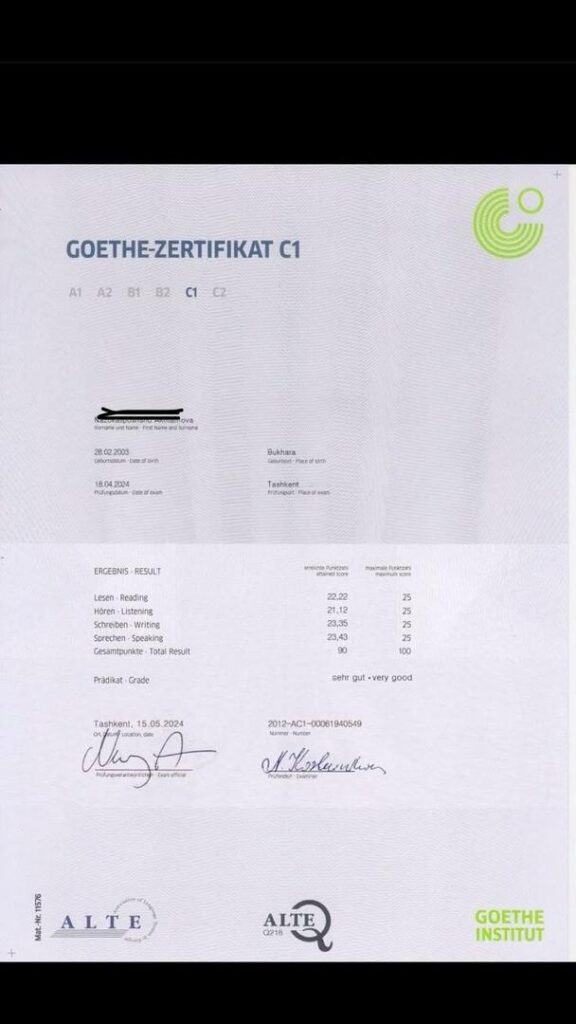

So, you’ve set your sights on the Goethe-Zertifikat C1. This isn’t just any language exam; it’s a prestigious credential that shouts to the world, „I am a confident and competent German speaker.“ Achieving this level signifies you can understand a wide range of demanding texts, express yourself fluently and spontaneously, and use the language effectively for social, academic, and professional purposes.Goethe Zertifikat C1
It’s a challenging but incredibly rewarding goal. Whether you need it for university admission, a professional career, or personal pride, this guide will walk you through everything you need to know to prepare for and pass the Goethe-Zertifikat C1.
What is the Goethe Zertifikat C1 Exactly?
The Goethe-Zertifikat C1 is an official German language exam for adults, administered by the Goethe-Institut, the Federal Republic of Germany’s cultural institute operational worldwide. It corresponds to the sixth level (C1) on the six-level scale of the Common European Framework of Reference for Languages (CEFR).
At this advanced stage, you’re moving beyond everyday conversations. The C1 level demonstrates you can:
· Understand complex, longer texts and grasp implicit meanings.
· Express ideas fluently and spontaneously without much obvious searching for expressions.
· Use language flexibly and effectively for social, academic, and professional purposes.
· Produce clear, well-structured, detailed text on complex subjects.
Why Bother? The Power of a C1 Certification
You might be wondering if all the effort is worth it. The answer is a resounding yes. Here’s why:
· University Admission: A Goethe C1 certificate is often a prerequisite for studying at a German university (Hochschulzugang).
· Career Advancement: For many professions, especially in fields like engineering, medicine, and research, a C1 certificate is a significant career booster and sometimes a formal requirement.
· Proof of Integration: In some German federal states, a C1 certificate can be part of the requirements for certain residency permits or citizenship applications.
· Personal Achievement: Reaching this level of fluency is a monumental personal milestone that opens up a new world of German literature, media, and culture.
Deconstructing the Exam: A Section-by-Section Breakdown
The Goethe-Zertifikat C1 exam is thorough, testing all four core language skills. Understanding the structure is the first step to conquering it.
The exam is typically split into two parts on the same day: a written block (Reading, Listening, Writing) and an oral block (Speaking), sometimes with a short break in between.
- Lesen (Reading) – 70 Minutes
This section assesses your ability to understand a variety of text types. You’ll encounter:
· Text 1: A longer, often journalistic or literary text where you match paragraphs to headings or statements.
· Text 2: A shorter text where you answer multiple-choice questions.
· Text 3: A „comment chain“ or series of short texts (e.g., from an online forum) where you must identify which person made which statement.
Pro Tip: Don’t try to understand every single word. Focus on the main ideas, opinions, and the gist of each section. Skim the questions first so you know what information to look for.
- Hören (Listening) – 40 Minutes
Your ability to comprehend spoken German from various sources is tested here.
· Part 1: A radio interview or discussion. You answer multiple-choice questions.
· Part 2: A short presentation or report. You complete a summary by filling in missing information.
· Part 3: An informal conversation (e.g., between friends). You decide if statements about the conversation are true or false.
Pro Tip: You will hear each recording only once in Parts 1 and 3, and twice in Part 2. Practice listening to authentic German radio (like Deutschlandfunk) and podcasts to get used to different accents and speeds.c1 goethe zertifikat
- Schreiben (Writing) – 80 Minutes
This is where you demonstrate your ability to produce a structured and coherent text. You are given one or more statistical graphs or charts and a statement or question related to the data. Your task is to write a formal text, such as:
· A letter to the editor.
· A comment for a professional website.
· A formal essay.
You are expected to describe the data, discuss the given statement, and present your own well-argued opinion.
Pro Tip: Structure is key! Follow a clear format: Introduction (describe the data and state the topic), Main Body (present arguments for and against, including your own viewpoint), and a Conclusion (summarize your opinion). Use a range of C1-level vocabulary and complex sentence structures.zertifikat c1 goethe
- Sprechen (Speaking) – 10 or 15 Minutes (plus 15 minutes preparation)
The oral exam is usually done with a partner. It has two parts:
· Part 1: A Presentation (Vortrag) – You are given a topic with two options. After 15 minutes of preparation, you give a short, structured presentation on your chosen option.
· Part 2: A Discussion (Diskussion) – You and your partner discuss a question related to the presentation topics. This tests your ability to react spontaneously, agree, disagree, and engage in a natural dialogue.
Pro Tip: During your presentation, use linking words and a clear structure („Zunächst…“, „Darüber hinaus…“, „Zusammenfassend lässt sich sagen…“). In the discussion, be an active listener and build on what your partner says. Don’t just wait for your turn to talk.goethe c1 zertifikat
Your Strategic Preparation Plan
Cramming won’t work for the C1 exam. You need a consistent, strategic approach.
- Immerse Yourself: Make German a part of your daily life. Read Spiegel Online, Die Zeit, or novels by contemporary German authors. Watch German films and series without subtitles. Listen to German music and podcasts.
- Expand Your Vocabulary Actively: Don’t just make lists. Learn words in context, create flashcards (digital tools like Anki are great), and focus on synonyms, idioms, and phrases typical for a formal register.
- Master Grammar Structures: At C1, you’re expected to use complex sentences with subordinate clauses, the passive voice, the subjunctive (Konjunktiv I & II), and participles correctly. Review these areas thoroughly.
- Practice with Official Materials: The Goethe-Institut website provides a treasure trove of resources, including modelltests (practice exams). Use them under timed conditions to simulate the real exam experience.
- Find a Speaking Partner: This is non-negotiable. Find a tutor, a Tandem partner, or a study group to practice the speaking format regularly. Record yourself to identify areas for improvement.zertifikat c1 goethe
Final Words of Encouragement
The path to the Goethe-Zertifikat C1 is demanding, but it is a journey that will transform your relationship with the German language. It pushes you from being a „learner“ to being a true „user“ of the language. With focused preparation, consistent practice, and a clear understanding of the exam’s demands, you can walk into the test center with confidence.Goethe Zertifikat C1, goethe c1 zertifikat ,zertifikat c1 goethe , c1 goethe zertifikat
Viel Erfolg bei Ihrer Prüfung! You have the goal, and now you have the plan. Go make it happen.