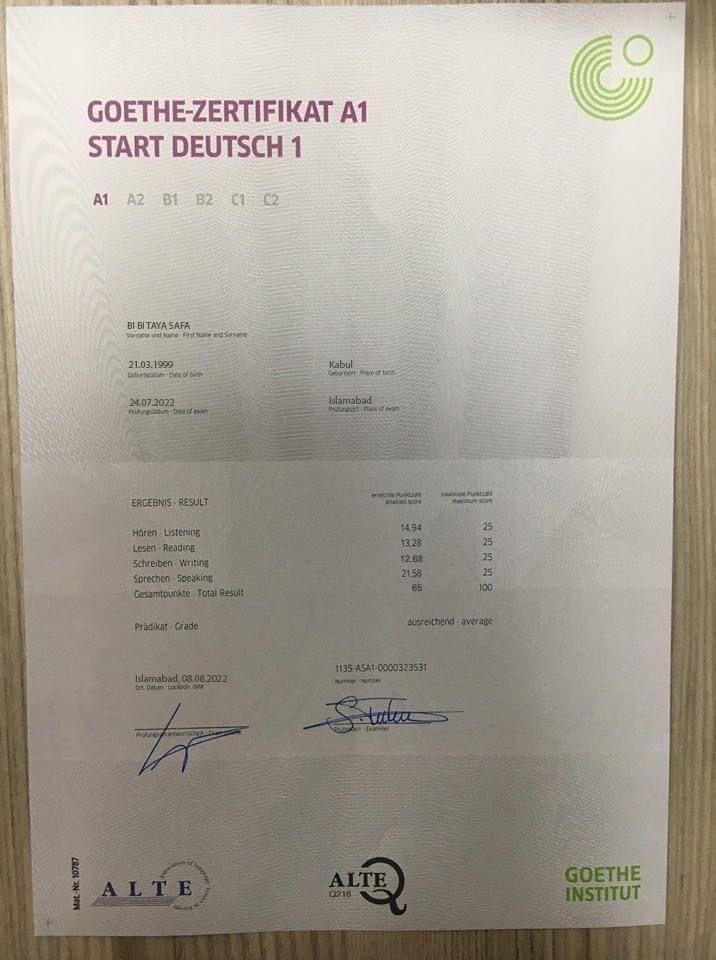

goethe zertifikat a1. So, you’ve decided to embark on the exciting journey of learning German, and your first major milestone is the Goethe-Zertifikat A1. Often called the „Start Deutsch 1,“ this exam is your official passport into the world of the German language. It’s the proof that you can take those first, crucial steps in understanding and using everyday expressions.goethe zertifikat a1
Whether you need it for a spouse visa, to join a family member, or simply to validate your initial progress, the A1 exam can seem like a daunting mountain to climb. But fear not! With the right strategy, resources, and mindset, it’s a mountain you can absolutely conquer. This guide will walk you through everything you need to know—from the exam structure to a step-by-step preparation plan.
What Exactly is the Goethe-Zertifikat A1? goethe zertifikat a1
The Goethe-Zertifikat A1 is an official German language exam for adults, administered by the Goethe-Institut, a globally recognized cultural institution. It corresponds to the A1 level of the Common European Framework of Reference for Languages (CEFR). At this level, you are not writing philosophical essays or debating complex politics. Instead, you are proving you can:
· Understand and use familiar, everyday expressions and very simple sentences.
· Introduce yourself and others.
· Ask and answer questions about personal details, such as where you live, people you know, and things you own.
· Communicate in a simple way when the other person talks slowly and clearly and is prepared to help.
Think of it as the foundation upon which your entire German language house will be built. A strong A1 foundation makes learning at the A2, B1, and higher levels significantly easier.
Why is the A1 Certificate So Important?
For many, this little certificate is more than just a piece of paper; it’s a key that unlocks important life events.
· Family Reunification: For many countries, especially for spouses joining their partners in Germany, providing an A1 certificate is a mandatory visa requirement.
· Personal Achievement: It provides a clear, structured goal for beginners, offering a tremendous sense of accomplishment and motivation to continue learning.
· Official Benchmark: It’s an internationally recognized standard that objectively measures your initial language skills, which can be useful for certain internships or au pair positions.goethe zertifikat a1
A Deep Dive into the Exam Structure
The Goethe-Zertifikat A1 exam is divided into four modules, testing the four core language skills: Reading, Listening, Writing, and Speaking. You must pass all four parts to pass the exam overall.
Let’s break down each section:
- Lesen (Reading) – 25 points – 25 minutes
This section tests your ability to understand very short, simple texts.
· Part 1: You might read short notices, advertisements, or signs and answer multiple-choice questions.
· Part 2: You’ll match short texts (like profiles or announcements) to specific statements.
· Part 3: You will read a short, simple text (e.g., a short email or a classified ad) and answer true/false or multiple-choice questions.
· Part 4: A small, straightforward form or notice where you need to extract specific information.
Preparation Tip: Practice reading everything you can find at this level—train station signs, simple recipes, short text messages. The Goethe-Institut website offers excellent practice material.
- Hören (Listening) – 25 points – 20 minutes
This can be the most intimidating part for many, as the recordings are played only once (for some parts) or twice.
· Part 1: You listen to short, everyday conversations or announcements and decide if a statement is right or wrong.
· Part 2: You hear a short, private telephone message or a similar recording and need to extract specific information like a name, a time, or a number.
· Part 3: You listen to an everyday conversation (e.g., in a shop or cafe) and match the information to a list of options.
· Part 4: You hear a short interview or a longer monologue and answer multiple-choice questions.
Preparation Tip: Immerse yourself in slow German. Use resources like „Slow German“ podcasts, or watch German children’s shows. The key is to get your ear accustomed to the sounds and rhythm of the language, even if you don’t understand every word.
- Schreiben (Writing) – 25 points – 20 minutes
This section is straightforward but requires precision.
· Part 1: You will be asked to fill out a simple form (like a hotel registration or a library card application). You need to transfer information correctly.
· Part 2: You are required to write a short, personal text or message. This is usually a text of about 30 words. The prompt will give you clear points you must include (e.g., „Write an email to a friend. Invite them to your birthday. Say when and where it is.“).
Preparation Tip: Memorize standard phrases for invitations, apologies, and thank-you notes. Practice writing short messages every day. A common mistake is writing too much; stick to the word limit and answer the prompt exactly. Accuracy is more important than creativity at this stage. goethe zertifikat a1
- Sprechen (Speaking) – 25 points – 15 minutes.a1 goethe zertifikat
The speaking test is usually done in a group of two to four candidates. Don’t worry; the examiner is there to help you, not to intimidate you.
· Part 1: You introduce yourself. You will say your name, where you live, your country of origin, etc. This part is prepared in advance.
· Part 2: You ask and answer simple, everyday questions with your partner(s). For example, you might ask about hobbies, family, or possessions.
· Part 3: You are given a card with a request on it (e.g., „Invite someone to the cinema.“). You must formulate a question based on the card and ask your partner.
· Part 4: You are given a card with an image or a situation (e.g., „You need a pen.“) and you must make a request based on it.
Preparation Tip: Practice with a partner! This is non-negotiable. Record yourself speaking to get over the fear of hearing your own voice in German. Learn fixed phrases for asking questions („Wie bitte?“ – Pardon?), buying time („Moment mal…“ – Just a moment…), and making requests („Könnten Sie mir bitte helfen?“ – Could you please help me?).a1 goethe zertifikat
Your 8-Week Step-by-Step Preparation Plan
Success on the A1 exam is about consistent, focused practice. Here’s a sample 8-week plan.
Weeks 1-2: Laying the Foundation
· Grammar: Master the present tense of regular (weak) and a few key irregular (strong) verbs. Learn the verb „sein“ (to be) and „haben“ (to have) inside out.
· Vocabulary: Focus on the first 250-300 words. Themes: Personal details, family, food and drinks, numbers (0-100), telling time, days of the week.
· Practice: Start a vocabulary notebook. Listen to 10 minutes of slow German daily.a1 goethe zertifikat
Weeks 3-4: Building the Core
· Grammar: Introduce articles (der, die, das) and the nominative & accusative cases. Learn possessive pronouns (mein, dein). Start with modal verbs (möchten – would like, können – can).
· Vocabulary: Expand to themes: hobbies, daily routine, the city, directions, weather.
· Practice: Begin writing one short sentence per day in a journal. Try to read one very short text online.a1 goethe zertifikat
Weeks 5-6: Practice and Application
· Grammar: Learn the imperative (giving commands/requests). Practice prepositions with accusative (e.g., für, ohne). Solidify sentence structure.
· Vocabulary: Review all previous themes. Add: travel, clothing, colors, body parts.
· Practice: Do your first full set of practice exams for Reading and Listening. Identify your weak spots. Find a language partner for 15-minute speaking sessions twice a week.a1 goethe zertifikat
Weeks 7-8: Exam Simulation and Refinement
· Grammar: Final review. Focus on your personal problem areas.
· Vocabulary: Intensive review of all A1 thematic fields.
· Practice: This is the crunch time. Simulate the entire exam under timed conditions. Do at least 2-3 full mock exams. Record and critique your speaking answers. Practice filling out forms perfectly.
Common Pitfalls and How to Avoid Them. goethe zertifikat a1
- Ignoring the Speaking Part: Many students focus only on the passive skills (reading, listening). The speaking test requires active production, which is a different skill. Practice it actively.
- Not Understanding the Instructions: The exam instructions are in German. Make sure you know what „Kreuzen Sie an“ (mark with an X) or „Ergänzen Sie“ (complete) means before you walk into the exam.
- Getting Stuck on One Question: The exam is timed. If you don’t know an answer, move on. You can always come back if you have time at the end.
- Trying to Be Perfect: At the A1 level, communication is the goal, not perfection. It’s better to say a sentence with a small grammatical error than to say nothing at all.goethe zertifikat a1
Beyond the Exam: The Importance of Proper Documentation
Once you pass your exam, you’ll receive your certificate—a document you may need to present for official purposes like visa applications. This is a critical piece of your journey. When dealing with German authorities, the presentation and, in some cases, certified translation of your documents matter immensely.
For a seamless process, especially for life-changing steps like family reunification, ensuring all your paperwork is in perfect order is crucial. This is where professional services can be invaluable. If you need assistance with document certification, notarization, or navigating the bureaucratic requirements for your move to Germany, consider reaching out to experts who specialize in this field. A resource like Paperwork Solutions can provide the support you need to ensure your administrative transition is as smooth as your linguistic one. You can learn more about their services at https://paperworksolutions.de.
Final Words of Encouragement
The Goethe-Zertifikat A1 is an achievable goal. It requires dedication, but it does not require genius. Embrace the mistakes you will inevitably make along the way; they are proof that you are trying. Celebrate the small victories—the first time you understand a German song lyric, the first time you successfully order a coffee, the first time you write a complete sentence without looking at your notes.a1 goethe zertifikat
You are not just learning a language; you are unlocking a new part of the world and a new part of yourself. Take a deep breath, make a plan, and start. Your German adventure awaits.goethe zertifikat a1
Viel Erfolg! (Good luck!)